Not able to open wide
A very common problem that patients are referred to me in my practice is for limited jaw opening. Limited opening presents as not being able to open more than 35 mm (2 vertical finger widths). The onset of limited opening can be gradual but is usually sudden. Ideally you should be able to open your jaw pain-free to 40-55 mm, which is about 3 vertical finger widths. As your jaw opens and closes the condyle (ball) moves in and out of the fossa (socket). There are 7 distinctly different causes of limited opening, each requiring different treatments.
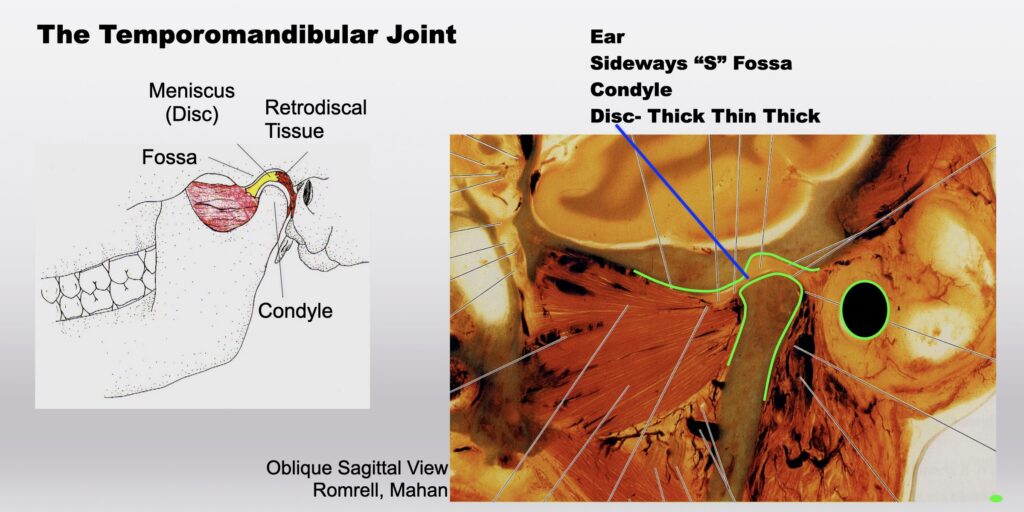
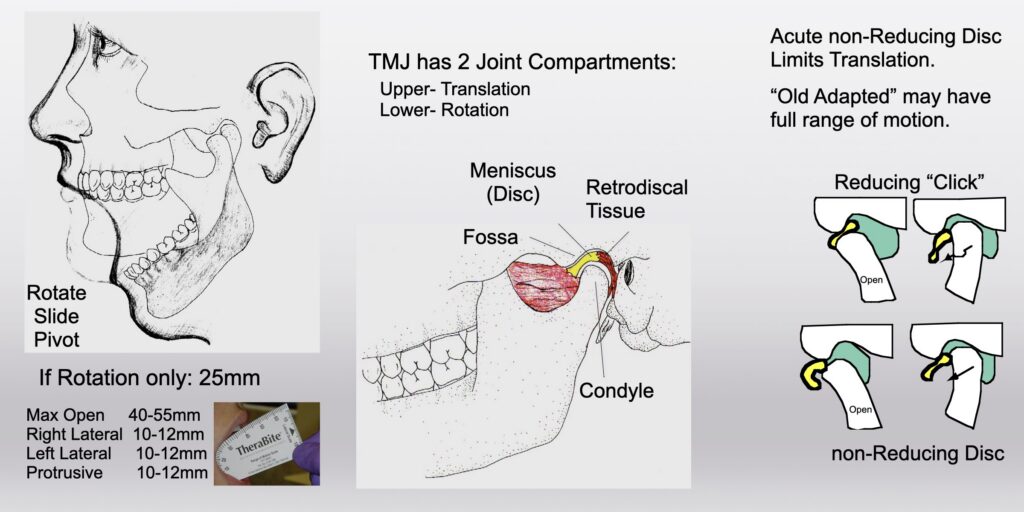

Different Causes of Limited Jaw Opening:
Pain Avoidance Sore Joint,
Pain Avoidance Sore Muscle,
Muscle Spasm,
Masseteric Space Infection,
Nonreducing Disc (4b,3b Acute),
Joint Fibrosis,
Muscle Fibrosis,
Other.
To determine the specific cause diagnostic tests need to be run. It needs to be determined whether the cause is the joint or the muscles or both.
Diagnostic Tests Needed:
History: How long limited opening has existed
Body Temperature
Caries Exam, Perio exam
Range of Motion: open, side to side
Gentle Active stretch: Point to area of pain
Anterior Stop Test
If needed CBCT, MRI
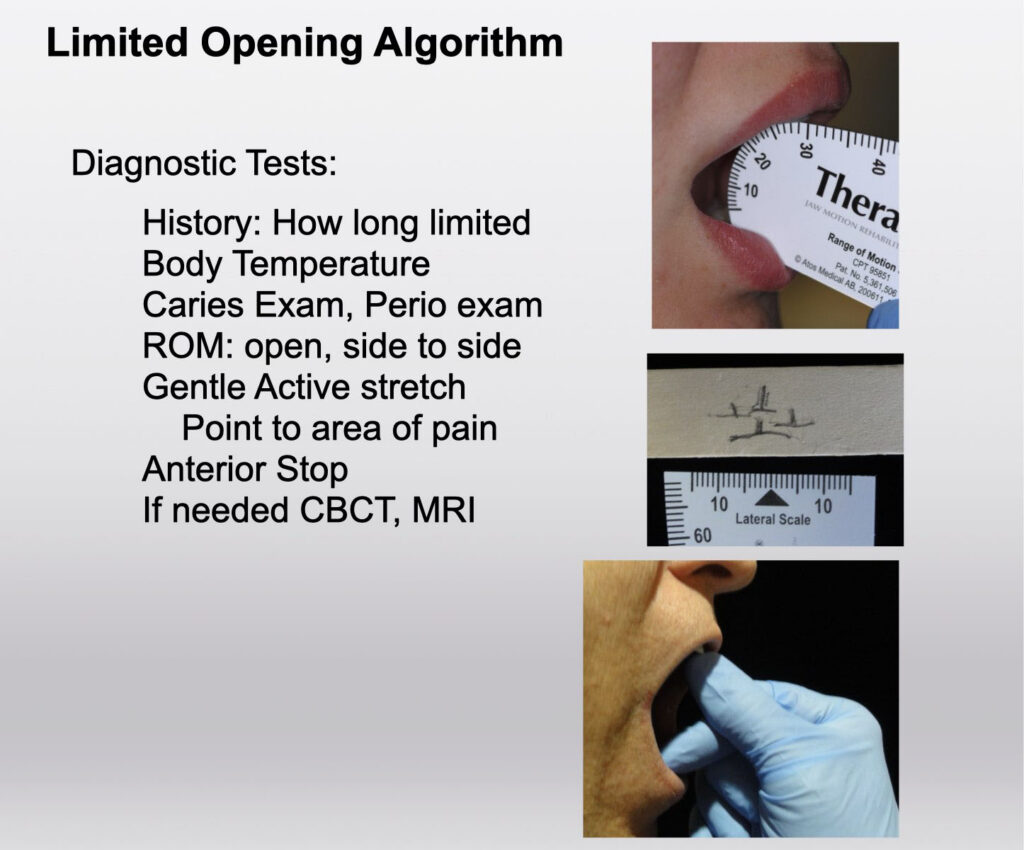
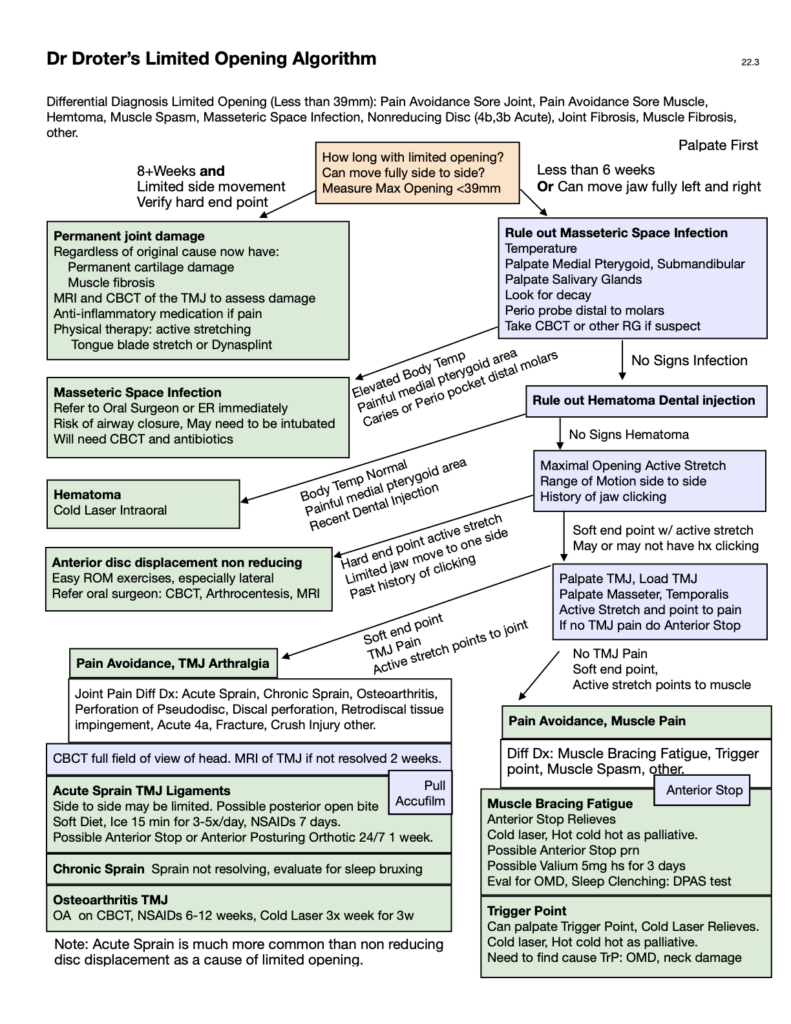
Using the above tests results and using Dr Droter’s flow chart a likely cause can be determined and effective treatments rendered. If you suspect a masseteric space infection, which presents as swelling behind the angle of mandible, difficulty swallowing and or throat soreness, see a doctor immediately.
TMJ Arthralgia (Sore Joint)
The most common cause of limited opening I see is a sore Temporomandibular Joint limiting jaw movement. The brain tries to avoid pain so it limits the jaw movements. A defining feature of a sore jaw joint that is limiting jaw opening is what I call a soft endpoint. If the jaw is gently and slowly supported and stretched with a thumb on top tooth and index finger on bottom tooth, the jaw will gradually open wider. This identifies that the jaw can move but is being limited by the brain telling the muscles not to move. A hard end point is when the jaw can not be gently stretched to a wider opening. A hard end point is an indication of a anteriorly displaced disc that is not reducing. See section on Anteriorly dislocated discs.
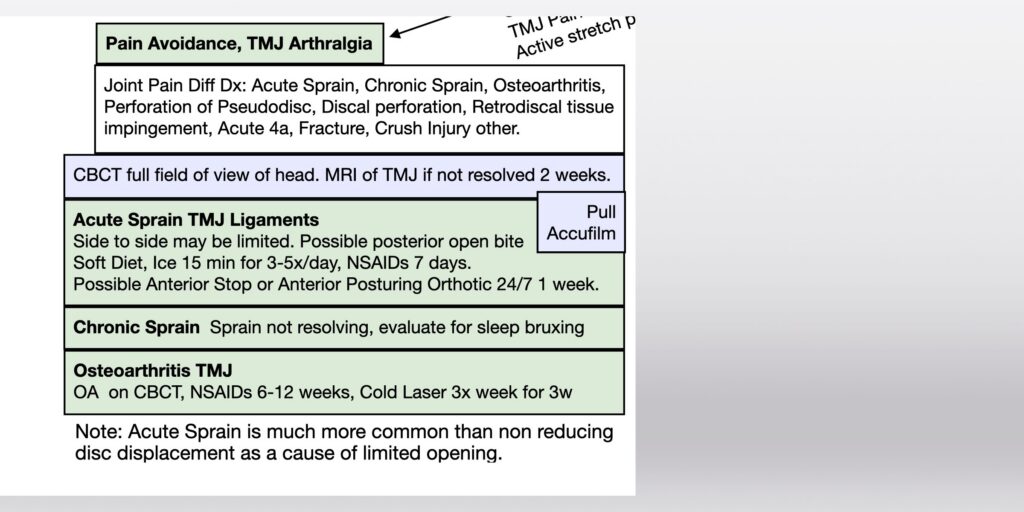
If a sore jaw joint is identified as the cause of the limited opening, one needs to figure out what is causing the jaw joint to be sore.
Sore TMJ Differential Diagnosis: Acute Sprain, Chronic Sprain, Osteoarthritis, Osteolysis, Perforation of Pseudodisc, Discal perforation, Retrodiscal tissue impingement, Acute 4a, other.
The Most Common Cause of Limited Opening
Sprained ligaments of the Jaw Joint
The most common cause that I see of a sore jaw joint limiting jaw opening is an acute sprain. The TMJ can be sprained just like an ankle. A sprain is a stretching of a ligament. This can occur during sleep from parafunctional jaw movements. Joint swelling can cause the back teeth to not touch on biting down. The posterior open bite will resolve once the joint swelling from the sprain resolves . A CBCT would be helpful to rule out the other causes of a sore TMJ, but one can treat the sore joint as if it is a sprain without imaging.
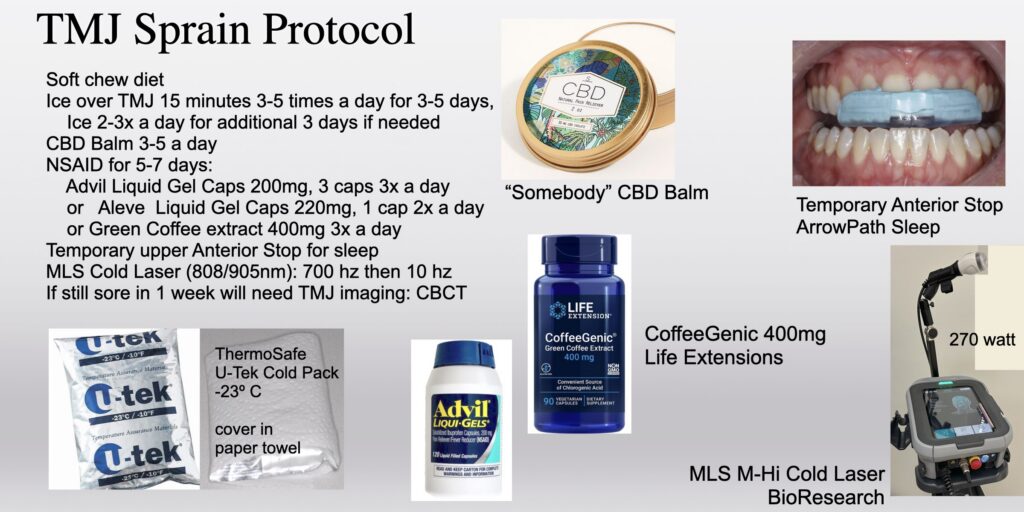
Acute Sprain Therapy:
Soft chew diet
Ice over the TMJ for 15 minutes 3-5 times a day for 3-5 days,
CBD Balm 3-5 a day
NSAID for 5-7 days:
Advil Liquid Gel Caps 200mg, 3 caps 3x a day
or Aleve Liquid Gel Caps 220mg, 1 cap 2x a day
or Green Coffee extract 400mg 3x a day
Temporary upper Anterior Stop for sleep
MLS Cold Laser (808/905nm): 700 hz then 10 hz
If still sore in 1 week will need TMJ imaging: CBCT
If the jaw is still sore in 1 week the most common cause is Osteoarthritis. This is easily identified on a CBCT. See section on Osteoarthritis for treatments.
If the jaw joint is still sore and limiting opening still persists an MRI scan is needed. Persistent joint soreness may require an arthrocentesis with platelet rich plasma to resolve the inflammation.
Sore Muscles causing Limited Opening
Limited opening caused by sore muscles is common but not easily diagnosed by most clinicians. Most medical doctors and dentists are not well trained in muscle palpation. If a person is bracing the lower jaw to avoid uncomfortable tooth contacts, the muscles become fatigued and get sore. if fatigued muscles are the cause, an anterior stop test to deprogram the muscles will allow them to temporarily relax and will restore full opening in about 3 minutes. If an anterior stop provides relief many palliative therapies that make muscles feel better will help, while corrective therapies aimed at creating a harmonious bite will resolve the issue without the need for continuous palliative therapy. See Occlusal Muscle Disharmony
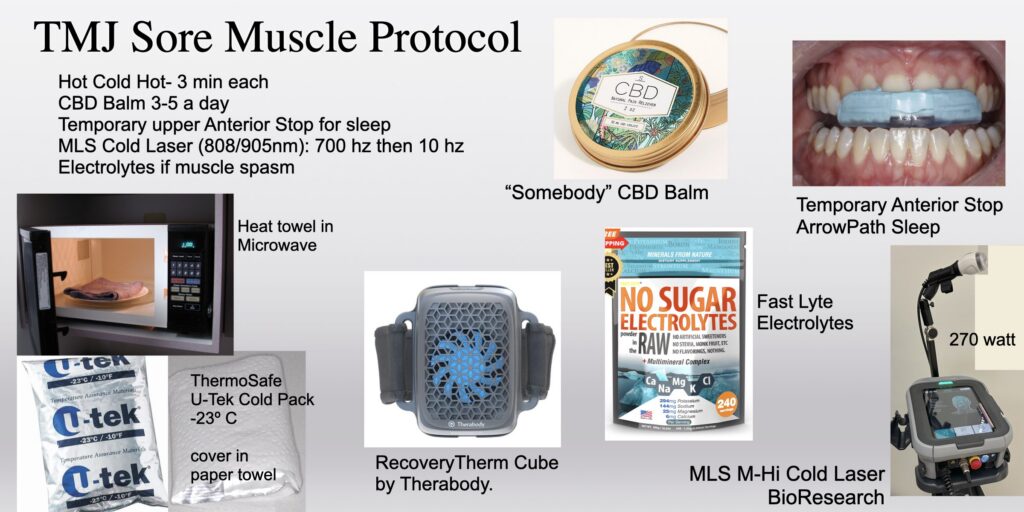
Additional Sore Muscle Therapies
I utilize an anterior stop deprogramming test on almost all of my new patients regardless of the amount of jaw opening to quickly relax the head and neck muscles and determine how much of their facial pain and headaches are due to sore overworked muscles.
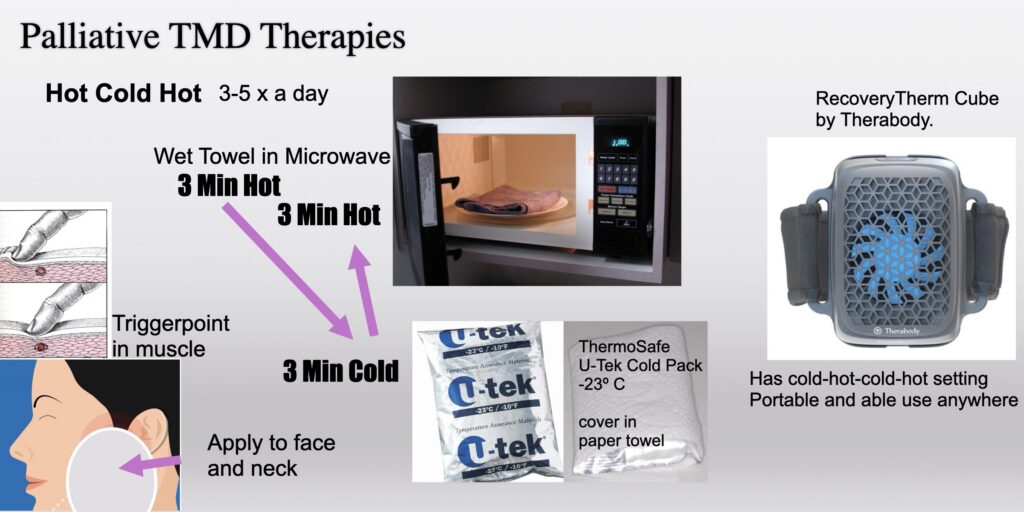
Home therapies include:
Hot Cold Hot- 3 min each
CBD Balm 3-5 a day
Temporary upper Anterior Stop for sleep
MLS Cold Laser (808/905nm): 700 hz then 10 hz
Electrolytes if muscle spasm
A muscle spasm will present as more painful than overworked bracing muscles and have a firmer end point on active stretching with muscle discomfort.
In the past I used TENS therapy to break the spasm. I now use the MLS M-Hi cold laser spasm setting for about 2 minutes. Cold laser takes less time than TENS and is more effective since it has lasting healing properties. Electrolyte imbalance in overworked muscles is also likely a factor so increasing electrolytes will help. Be sure and test for Occlusal Muscle Disharmony as that is usually the main underlying cause. See Occlusal Muscle Disharmony
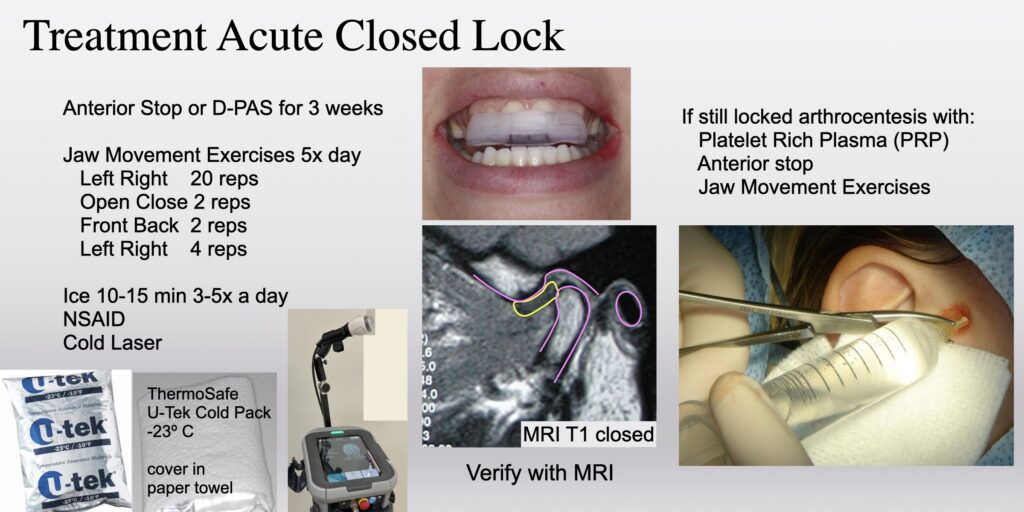
Acute Closed Lock: Stuck Disc
Most patients presenting to my practice with limited opening have been pre diagnosed with a non reducing TMJ disc, the disc is “stuck”. Less than 1/5 of patients have a stuck disc as the cause. The top 3 causes that I see are acute sprain, osteoarthritis, and Occlusal Muscle Disharmony.
Those with a stuck disc will present with a hard end point in active stretching test and not be able to move their jaw fully side to side.
Treatments includes 2-3 weeks of jaw movement exercises, Ice, and anti inflammatory like Advil or Aleve and Cold Laser. If limited opening does not resolve an arthrocentesis with PRP is indicated.